
Categories
Uncategorized

The Right to Truth and Justice

Finding the Truth for Families of Persons Still Missing as a Result of Conflict in Northern Uganda

By Sylvia Opinia

One evening while finalising the preparations for the Dialogue on Disappearances
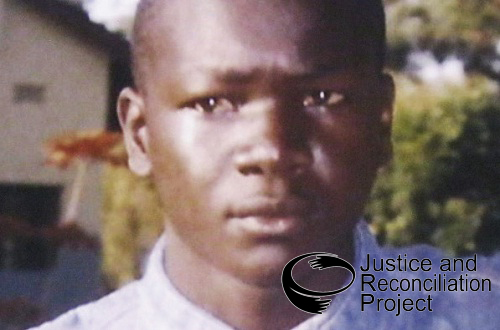
Neville Wachibra, who went missing in 2002, poses in an undated photo. Family photo.

to commemorate the International Day Against Enforced Disappearances on 30th August 2012, we pinned up posters made by JRP in collaboration with Children/Youth as Peace Builders (CAP) Uganda, as an indicative list of missing persons in Gulu District. The waiter who brought our drinks suddenly stood there for some time while skimming through the names and finally asked one of my colleagues how he could get the name of his missing relative to be included on the poster. What caught my attention was not the question but the fact that in Northern Uganda almost every family has or knows of a family member who is missing.

Neville Wachibra for instance, is Norah Fathum’s eldest son. He went missing after an attack on a Nile coach bus on 19th September 2002 along Karuma – Packwach road just before he began his first year at Makerere University. To this day, Norah does not know the whereabouts of her son while the younger brother Emmanuel has to cope with the trauma of losing his role model at a young age. Julius Odonget is the son of Robert and Anna Okanya of Obalanga sub-county, Amuria District in Teso sub-region. In 2003, Julius was abducted with his sister after the LRA entered Teso through Obalanga. His sister managed to escape from captivity but Julius’ whereabouts remain unknown. Josephine and Bua Peter also lost their son Maxwell Ayo. Today they continue to hope to find his remains so that they can conduct a proper burial for him.

Evelyn Amony’s daughter, born in captivity, went missing after fighting between the UPDF and the LRA broke out in Sudan. Rumoured to have been taken by the UPDF, Evelyn’s daughter remains separated from her mother. Martin Ononge talks passionately about his son in law and his son who joined Alice Lakwena’s Holy Spirit Movement to fight but were arrested by NRA soldiers and taken to the prison where they were forced to dig without adequate amounts of food to eat. After two years, some of the people that were arrested with them came back, but his son and son-in-law have still not returned. Ononge up to date continues to search for his missing son and son-in-law.

These and many similar stories are told from West Nile, Acholi, Lango and Teso sub regions, of loved ones who disappeared during the height of the conflict in Northern Uganda. Amidst the immense post conflict challenges, those whose relatives are still missing and/or unaccounted for continue to seek answers to the whereabouts of their loved ones yet the issue of those who disappeared during the conflict has not made it to the national agenda.

 The International Committee of the Red Cross (ICRC) defines missing persons as all those whose families are without news of them and/or are reported missing, on the basis of reliable information, owing to armed conflict. These include those disappeared by the state or taken by armed groups, children forcibly recruited or adopted, combatants missing in action and those in clandestine detention. It goes further to classify that in addition to the direct victim of disappearance, the families of the missing are its victims. In Northern Uganda, civilians have disappeared in the hands of both government and rebel forces. Though the magnitude (numbers of those missing) is not known, recent studies conducted by CAP, a local NGO working in the Acholi sub-region, indicates that in Gulu district alone, those who are still missing account for 29.5% of the total number of abductions by the LRA. Yet apart from local community based initiatives to search for their loved ones, at national level, no interventions have been put in place to deal with this major concern.

The ICRC, Amnesty International, the International Convention for the Protection of all People from Enforced Disappearances and the Rome Statute among others have gone further to justify that indeed knowledge about the whereabouts or establishing facts about what happened to their loved ones is a right for the families of the disappeared, as well the first step towards a process of seeking redress for their missing relatives.  In our studies on truth-telling (see the series of JRP publications on www.justiceandreconciliation.com), we were able to find out that indeed people want to know something about what happened to their missing persons, siblings, children and spouses. Right from 1986 when the LRA/GoU conflict started, we have heard stories of people gone missing, to be unaccounted for either by state security agents or by the rebels, to date victims have remained silent but not silent because they are happy but because they have not been given the opportunity to come out and express their grievances about their loved ones gone missing.

Bringing the issues of accountability and reconciliation on the national agenda at Juba and the consequent developments within JLOS has been a milestone worth applauding. However, the next milestone is, are these issues going to be particular to those who were affected? Are they going to address the real victims who still suffer to date? What about missing persons, are they going to be fully incorporated into our proposed transitional justice (TJ) policy being generated by JLOS. Are we going to pretend to develop a TJ process that does not look at the issue of those who are still missing? That at the end of the TJ process will we have achieved anything if thousands of families in Northern Uganda still do not know the whereabouts of those who have gone missing?

 Much as one can argue in theory, that all the TJ mechanisms can play a role in one way or the other to address the issue of missing persons, it is important to note that this begs for special and adequate consideration for a well facilitated justice mechanism based on the right truth and relevant information. So the question of missing persons remains an integral component of a truth-telling process in Uganda. Ideally when speaking about truth-telling, one fundamental aspect that ought not to be ignored for the case of Northern Uganda is the question “where is the missing person?” Take for instance abductions of plenty of children and adults, those who served as foot soldiers in the LRA, how many were they? Though we do not have actual figures, they constituted a big number of the population who are either killed or disappeared. Formerly Abducted Persons have come back without a detailed account of where their colleagues who were in the rebellion are. We need a mechanism where these issues are brought to our attention for us to get to know their whereabouts and who is responsible.

Hence for any TJ process and a truth-telling process for this matter to be meaningful, these are issues to be confronted with. We still remain optimistic that something will be done, that finally the government, the NRA/UPDF will come out and say “look this is what happened to those who were abducted; that your children whom we did not protect are languishing in the jungles of DRC or they have actually died in our hands and we should move forward as a nation and heal the wounds of those who still think that tomorrow their loved ones will be back or they will locate their remains”.  These are issues that need to be addressed at that level.

This however can only be possible if the key stakeholders especially the GoU formally acknowledge the fact that this is a problem that requires intervention by putting it on the policy agenda. JRP through its “Right to Know Campaign” has created a platform for families and relatives of the missing to explore and situate the concerns and anguish of families/relatives of missing persons. We hope that this campaign will heighten awareness and draw the attention of the GoU, CSOs, donor community and the public about the missing or people who are unaccounted for as a result of conflict and the anguish of their families.

It’s therefore my passionate appeal to all key stakeholders especially the civil society fraternity, that the missing person is a very crucial area that we as practitioners in Northern Uganda must begin paying attention to. It is our role to garner the support of victims and other like-minded CSOs to begin looking at these issues and push them to the agenda of government. As a way forward, I challenge that we work together to embrace the issue, generate momentum and raise hope in the victims who are still searching for answers and/or healing. This is the time for closure for victims and for CSOs to become a relevant force to reckon with the past that these victims have been through. ▪

 Sylvia Opinia is the Team Leader for JRP’s Community Mobilisation Department.
 

Categories
Uncategorized

Letter from the PC

Dear Readers,

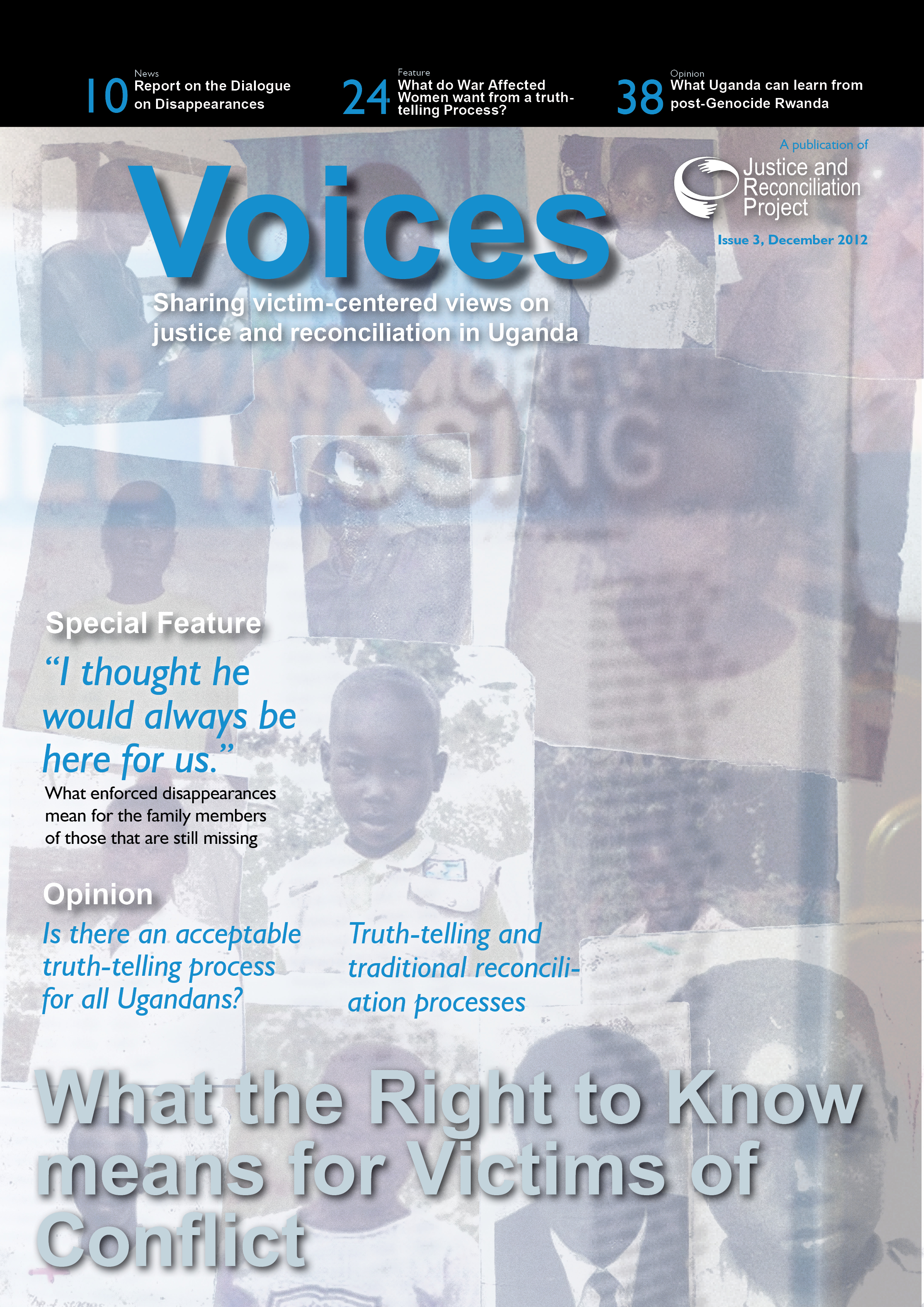
Welcome to our latest edition of Voices Magazine where we bring you some local perspectives on the ‘Right to Know’. In August JRP launched the ‘Right to Know’ campaign to draw attention to the significance of truth seeking and missing persons in the transitional justice discourse in Uganda. Key to this campaign is the legacy of the various conflicts that have occurred in Northern Uganda leaving hundreds of persons gone missing and in need of the truth of their whereabouts.

From its inception, JRP has been overwhelmed by the number of persons who claim they have lost their loved ones while others have gone missing. The most pronounced of these incidents have been attributed to LRA abductions, more especially to their method of forcibly recruiting innocent civilians to their ranks, torture, killing and maiming. However, we are also aware that another worrying trend of atrocities, such as disappearances in the past has been orchestrated by state agents. These however have largely been unspoken of, or even unreported. In fact, many families to date are still at bitter terms with the government for having a hand in the numerous disappearance persons gone missing in Northern Uganda as testified by one elder: “As the new government took over power they turned against the very people they claimed to have fought for. My children and several other relatives in this area went missing on accusations that they were collaborators. I am now an old man with no children …”

In August 2012, when we got together families/representatives of victims across the greater Northern Uganda in Gulu town, our anticipation (as usual) was to begin a dialogue around the ‘Right to Know’. The dialogue which begun at Gulu town in August should go a long way in re-awakening our thoughts around truth seeking and missing persons. From the August dialogue with victims and families of the missing, I learnt that the term ‘missing persons’ should be understood in its broadest sense. Missing persons or persons unaccounted for are those whose families are without news of them and/or are reported missing on the basis of reliable information. People become unaccounted for due to a wide variety of circumstances, such as displacement, whether as an internally displaced person or a refugee, being killed in action during an armed conflict, or forcibly or involuntarily disappearing. The issue of missing persons is thus intrinsically linked with the respect of rights of the families concerned. One of those fundamental rights is ‘Right to Know’ what happened to the loved ones.

This newsletter therefore in part seeks to give a voice to the missing persons, aware that Uganda is on course with developments around truth-telling. We do this because we know that in war many people go missing, causing anguish and uncertainty for families and friends. People have the right to know what happened to their missing relatives while at the same time governments, the military authorities and armed groups have an obligation to provide information and assist efforts to put families back together. Through the newsletter, we anticipate that the voices of those who still live in pain seeking to mourn their loved ones are reflected within the broader agenda of truth-telling and reconciliation in Uganda.

We assert that the lack of attention paid to the issue of truth-telling and more specifically missing persons doesn’t only give anguish to the families, but also hampers the efforts at reconciliation and a return to peace and stability in Northern Uganda. The ‘Right to Know’ goes beyond the ordinary pain and anguish suffered by individuals, but also the whole community who collectively have a duty to make peace and reconcile with their neighbours/perpetrators with whom they most often live side by side. We shall continue to work with victim/family networks since we have learnt they play an important role in the ‘right to know’ as well as in promoting public recognition of the problem. We believe what we have started through exchange of information between the victim networks across the different regions in the greater Northern Uganda could significantly influence the reconciliation process in the region. It should also help advance the cause of justice for the victims and their families, who want their loss to be taken into account.

Just like any transitional justice process, the ‘right to know’ should be depoliticised in a manner that binds all stakeholders without making any differences based on the ethnic or regional origin of the problem. Every victim has a ‘right to know’ therefore the call to address the plight caused by disappearance can never be underestimated by civil society and government of Uganda as narrated throughout the text of this magazine issue.

Finally, I take the opportunity to thank all our readers and the support shown throughout the year 2012. I also convey my gratitude to all the contributors to this magazine issue.

Categories
Newsletters & Magazines

Voices Magazine Issue 3


Voices Issue 3 (pdf)

Editorial

Justice, Reconciliation and the Right to Know

Oryem Nyeko

In the middle of 2012, JRP began filming a documentary in Amuria District in Teso sub-region. We moved onto Lango, West Nile and Acholi sub-regions, where we interviewed the family and friends of individuals that are still missing because of enforced disappearances. Today, many parents, siblings and children continue to search for any information about what happened to their loved ones, a search, which to them, seemed to be being carried out alone.

The reality is that the abductions and enforced disappearances did not just affect those that were close to the missing. Instead, the issue is intertwined closely with communities in the region as their transitional justice needs become further defined. The search for the truth is not confined to a search for missing persons, but extends to the struggle for acknowledgment from those that are responsible, or partook in the two decade long conflict.

In this issue of Voices magazine, truth-telling is the central theme. The “Missing Persons Poster” , is not an exhaustive list of the missing. It was meant to serve as a reminder of the scale of the challenge and the importance of a campaign aimed at advocating for victim-centred truth-telling process in a post-conflict region like Northern Uganda.  While it is impossible to accurately depict how many people are missing, it is hoped that this poster, among many other community-led initiatives, will lead to ‘the Right to Know’ being a serious priority in the agenda of the Government and other stakeholders (“The Right to Truth and Justice”).

The work of the ICRC in particular, in tracing missing abductees and reuniting them with family member, reflects a general sentiment of truth-seeking as an internationally recognised right. Guest writer Simon Robins examines the work of the organisation in “Missing Persons: Towards a Victim Centred Approach” . Proposed telling processes in this region are also examined from a gender perspective (“Achieving Gender Justice Through Truth-Telling”, page 26), and comparisons are made with countries in a post-conflict states (“Lessons from Post-Genocide Rwanda”, page 38)

The Gender Justice initiative, the Women’s Advocacy Network (WAN), consists of women that were personally affected by the conflict, some of whom actually know the whereabouts of some of the missing persons. The Chairlady of the advocacy initiative, Evelyn Amony, calls on individuals, organisations and governments to come together to restore the broken links in “Our Lost Jewels” .

 What does the Right to Know mean to you? We welcome the views of readers, so email voices@justiceandreconciliation.com or visit our offices in Gulu to have your voice heard.

Contents

Letter from the PC

By Boniface Ojok

WELCOME TO our latest edition of Voices Magazine where we bring you some local perspectives on the ‘Right to Know’. In August JRP launched the ‘Right to Know’ campaign to draw attention to the significance of truth seeking and missing persons in the transitional justice discourse in Uganda. Key to this campaign is the legacy of the various conflicts that have occurred in Northern Uganda leaving hundreds of persons gone missing and in need of the truth of their whereabouts.From its inception, JRP has been overwhelmed by the number of persons who claim they have lost their loved ones… Read more


The Right to Truth and Justice

By Sylvia Opinia

ONE EVENING while finalising the preparations for the Dialogue on Disappearances to commemorate the International Day Against Enforced Disappearances on 30th August 2012, we pinned up posters made by JRP in collaboration with Children/Youth as Peace Builders (CAP) Uganda, as an indicative list of missing persons in Gulu District. The waiter who brought our drinks suddenly stood there for some time while skimming through the names and finally asked one of my colleagues how he could get the name of his missing relative to be included on the poster. What caught my attention was not the question but the fact… Read more


Interview with Boniface Ojok

In the last few months, the ‘Right to Know’ campaign has formed a central part of JRP’s work. Voices Magazine sat down with JRP Programme Coordinator, Boniface Ojok, to get his insight on the campaign, its purpose and the hopes for the upcoming months. Read more.


Missing Persons: Towards a Victim Centred Approach

By Simon Robins

The conflicts over the last three decades in Northern Uganda have left many impacts, some better understood than others. The large-scale LRA abductions that have come to characterise the war in the Acholiland and beyond have produced a multi-faceted response targeting returnees, their families and communities. Returnees have benefitted from counselling in district-based reception centres, support on their return home and assistance packages. In some sense however these returnees and their families are the lucky ones: many families of those abducted have heard nothing about their loved ones and remain torn between the hope that they will return and the… Read more

The Dialogue on Disappearances

By Sylvia Opinia

To commemorate the internationally recognised day against enforced disappearances, the Justice and Reconciliation Project in collaboration with Children/Youth as Peace Builders (CAP) Uganda organised a dialogue on the 30th of August 2012 between stakeholders, victims groups and civil society organisations in Northern Uganda to generate debate on addressing the issue of people who are still missing or unaccounted for as a result of conflict. Guided by the theme “the right to truth”, this was part of a series of week long of activities organised by JRP in West Nile, Teso, Lango and Acholi sub-regions aimed at engaging with communities on the issue… Read more

Voices of Uncertainty

By Kamilla Hasager Jensen and Mia Jess

It is early morning and we have just arrived at a family compound in the outskirts of Gulu. We are greeted by the father of the family who is apologizing for being very busy that particular morning. It has been raining heavily all night and now he has to fix the latrine, which has been damaged by the rain. The father is weak and recovering from an illness, so the heavy work is hard for him to manage. He takes time out of his busy schedule to show us around his compound. While we are walking around we are talking … Read more


Providing Answers: What the ‘Right to Know’ means to victims in Northern Uganda

By Lino Owor Ogora

Despite experiencing close to four years of relative peace, Northern Uganda continues to grapple with several recovery challenges. Among these challenges are answered questions regarding the plight of people who continue to be missing. Many of these people were either abducted by the rebels of the Lord’s Resistance Army (LRA) or simply went missing due to other causes such as displacement. It is not known if many of them are still alive.

A survey conducted by an NGO called Children and Youth as Peace Builders (CAP) indicates that 1,036 people are missing in Gulu alone. A 2012 survey by JRP … Read more

Our Lost Jewels: The Women’s Advocacy Network and the Unaccounted For

By Evelyn Amony

Daniel is one of the boys who never got the chance to come back home like we did. Many of us were abducted but not all got the chance to come back. Some died and others are still alive. They live with other tribes in other countries. When Daniel finally found his way home, he told us about his fate and that of the other children. There are people who are still in Sudan and living among the Lutugu tribe. Some of the girls have become wives while the boys become soldiers.   The boys have also been given women from … Read more


We Want a Truth-Telling Process That Will Lead to Reconciliation

By Nancy Apiyo

Continuing from last issues ‘Ododo Wa: Our Stories’ (‘Storytelling, Gender and Reparations’ Voices, Issue 2, September 2012), JRP’s Gender  Justice department uses the mechanism of story telling to ascertain the views of war affected women on the Right to Know, truth-telling processes, missing persons and the need for reconciliation at community level. … Read more

Achieving Gender Justice through Truth-Telling

By Kasiva Mulli

With a proposed truth-telling process being considered at national level, Gender Justice Team Leader Kasiva Mulli examines the factors that need to be taken into consideration if such a process is put in place from a gender perspective… Read more


An Acceptable Truth-Telling Process for all Ugandans?

By Isaac Okwir Odiya

Uganda is well endowed with a number of ethnic groups with different ethnic value and beliefs which are key in guiding behaviours in societies. Each group values their belongings and lifestyle and always strives to defend it at any point. Every society values truth-telling as a fundamental instrument of promoting justice and peace for the good of the societies but justice which is believed to come through truth-telling varies from person to person, society to society depending on individual needs.

The disparities in justice needs of individuals and societies has turned to define what “truth-telling” is. It is therefore important … Read more

The First Step towards Reconciliation: The Role of Truth-Telling in Acholi Traditional Ceremonies

By Vicki Esquivel-Korsiak and Kate Lonergan

In exploring the relevance of traditional mechanisms to the unique justice needs of Northern Uganda, JRP’s Documentation department   found that truth-telling forms a central part of some reconciliatory ceremonies. In this article, mato oput and moyo kum specifically are examined vis-à-vis their role in truth-telling and the JLOS proposed transitional justice policy in Northern Uganda… Read more

Current Views and Perceptions of Truth-Telling in Northern Uganda

By Andres Jimenez

On Tuesday 18th July 2012, the Justice Law and Order Sector (JLOS) released its long awaited study on traditional justice and truth-telling. The one day launch event took place at Imperial Royale Hotel in Kampala. The report contained findings of a study on traditional justice mechanisms of tribes all over Northern Uganda, and truth-telling mechanisms. The report made policy recommendations on adoption of a national policy on truth-telling and traditional justice.

Following the launch of this report, JRP’s Community Documentation department decided to conduct a brief situational analysis on truth-telling within local communities, to analyse local perceptions and opinions on the subject… Read more

Gender Justice Activities from August to September

By Tamara Shaya

JRP’s Gender Justice Team engaged in a variety of activities over the past few months, which have yielded great results.

Under the Ododo Wa (Our Stories) program, the Gender Justice Team developed personal history books for several formerly abducted women. The personal history books, which include the life story about a woman’s life before, during, and after abduction, are important assets to the women. Many formerly abducted women feel the need to document the experiences they faced so that their children and families understand their experiences and for women to remember events that took place while in captivity.

Likewise, under … Read more

A Forged Reconciliation or Genuine One? Truth telling and Family Reconciliation

By Isaac Okwir Odiya and Can-Kara*

In 2012, Can-kara (not his real name) approached the Justice and Reconciliation Project in the hope that the organisation would be able to help provide a solution to a two-decade long family rift. Having searched and not found solutions in many places, he was unsure whether his family conflict would finally be resolved. This is his story, as told to JRP Project Officer Isaac Okwir Odiya… Read more

Truth-telling for Forgiveness and Reconciliation

By Kate Lonergan

In 1994, “Robert”, then 8 years old, was living in his uncle’s home.  Late one night, the LRA attacked the home and abducted Robert. As the rebels were taking him, Robert was forced to watch one of the commanders, who was scarcely older than himself, brutally beat and kill his uncle. For the first week of his captivity, Robert and the commander moved as part of the same battalion. Soon, though, they were separated.

Robert eventually escaped from the LRA in 1999 and found his way to a World Vision reception center in Gulu. A few weeks later, the same …  Read more

Lessons from Post-Genocide Rwanda: The Location, Identification and Respectful Burial of the Anonymous Victims of Mass Atrocities

By Erin Jessee

In the aftermath of the 1994 Rwandan genocide in which an estimated 800,000 civilians – most of whom were members of the nation’s minority Tutsi population – were killed, a number of initiatives have been pursued in an effort to locate and rebury with respect the anonymous victims of the violence. In the months following the genocide, survivors frequently attempted to learn the locations where their missing family members had been killed, and then conducted nonscientific exhumations aimed at locating and reburying with respect any human remains that might be found.

Then, in 1995 and 1996, the International Criminal Tribunal for Rwanda … Read more

Categories
In the News Media Newsroom

Land conflict no more! Community theater wows one community

http://grassrootsgroup.org/2012/12/land-conflict-no-more-community-theater-wows-one-community/

By Christopher Maclay

In May 2012, we began an exciting partnership with the Justice and Reconciliation Project (JRP) to pilot an innovative community theater approach which facilitates processes of problem examination and solving, develops empathy among participants, and encourages reconciliation. Two groups – Anga Konya (meaning ‘Who will help me?’) and Atoo Pi Iya (meaning ‘I will die for my stomach’) – were chosen for the pilot, as they had requested support in community theater activities.


Group members act out the violence of the LRA conflict, which they saw as the root cause of ongoing land wrangles

This November, the first phase of this pilot came to close, with Anga Konya and Atoo Pi Iya hosting a fantastic day-long event for their community. The groups had spent several months examining their problems through theater and developing their own solutions to these problems. The final community performances gave the groups the opportunity to present their findings and recommendations to their wider community.


Community members listen closely to the messages being shared

Both groups decided that their final performances should be on land conflict, and it was chosen that the title of the event should be: ‘My Land, My Heritage: land conflict and the need for reconciliation.’ Groups decided to host the event together, at a central location which the most people could reach. As part of the event, the group invited local politicians, as well as local traditional leaders. The chief guest was Otto Matthew, the Land Minister of the Ker Kwaro Acholi (the traditional cultural institution of northern Uganda).


The Local Councillor III presents his thoughts on the theater performances, and land conflict in the region

Each group put on a play that explored how land conflict arose out of the process when people across northern Uganda returned from displaced persons camps to their homes. Many people in northern Uganda lived in camps for up to twenty years during the terrifying Lord’s Resistance Army conflict, and land conflict continues to cause significant unrest in the region. The plays explained how land conflicts can arise, and showed how they can be solved; through mediation, discussion, forgiveness, and reconciliation.


Members of Atoo Pi Iya act out efforts to mediate a land conflict

After the performances had been completed, and the speeches made, group members excited the crowd with a follow-up performance of traditional dance and drumming. More pictures to come soon!

Categories
Blog

Reflecting on our work

As the year comes to an end, we at JRP find ourselves reflecting on both our accomplishments and the challenges we have faced in the past twelve months. We are also looking to the future: what will we do next year? How can we improve our work and what solutions can we find to the challenges we have faced this year? Recently, we held our inaugural Dissemination Forum in Gulu where we launched five of our most recent reports and Field Notes. Attended by local traditional and religious leaders, victims’ group representatives, civil society members and members of the media, the purpose of the Dissemination Forum was to provide a medium for the people for whom our reports are written to share their opinions on the reports and discuss the issues that are raised in them. We also used the opportunity to reflect on whether the reports are indeed serving their intended purpose – that is, to be a voice for victims of conflict and to share ideas about how to improve them.

Each report was presented in detail by researchers from the Community Documentation department, presentations which included discussions on the background and purpose of the reports, their research methodology, the findings that were made and the recommendations to stakeholders contained. Following the presentations, the participants in the Forum shared their views on each report. Many participants talked about the value of documenting victim centred views and experiences, while some emphasised the importance of policy makers receiving the content of the reports and initiatives of JRP and other CSOs.

“This forum should look at how we can get the state to understand that they have the responsibility,” one participant suggested. “[Otherwise] we may end up providing a lot of information without reaching the government.”

At the event, we screened a documentary entitled “The Guns May Be Silent, But the Struggle Continues” which examines the struggles that continue to be faced by communities affected by conflict in the Teso and Acholi sub-regions. Specifically, the documentary aims to address some of the most prominent transitional justice advocacy points that victims in Northern Uganda continue to face. The piece will be available to the public in the upcoming months.

The five reports we launched were:

The Day They Came: Recounting the LRA’s Invasion of Teso Sub-Region through Obalanga Sub-County in 2003. This report explores the impacts of the LRA incursion into Teso sub-region using case studies and victims’ testimonies from the sub‐county of Obalanga in Amuria district. This report can be accessed here.

When a Gunman Speaks, You Listen: Victims’ Experiences and Memories of Conflict in Palabek Sub-County, Lamwo District. This report focuses on Palabek’s history from 1986 to the present based on victims’ testimonies and information provided by interviewees. This report can be accessed here.

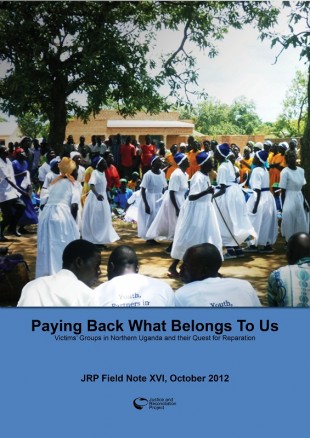
Paying Back What Belongs to Us: Victims’ Groups in Northern Uganda and their Quests for Reparation. This report serves to illuminate the current state, emergence and development of different victims’ groups and associations throughout the greater north of Uganda and to highlight their activities and demands. This report can be accessed here.

Gender and Generation in Acholi Traditional Justice Mechanisms: This report seeks to understand how traditional ceremonies are helpful to women and youth, and whether such ceremonies are relevant to the unique concerns women and youth face in post-conflict recovery. This report can be accessed here.

The Uganda Reconciliation Barometer 2012: With the Transitional Justice Monitoring Survey as its tool, the UG Reconciliation Barometer measures the attitudes and perceptions of Ugandans in the north on critical justice and reconciliation issues. This report can be accessed here.

See pictures of the Dissemination Forum on the 15 of November 2012 below.

[AFG_gallery id=’46’]

Categories
Publications Reports

UG Reconciliation Barometer 2012

The Uganda Reconciliation Barometer is a presentation of the attitudes and perceptions of Northern Ugandans on critical justice and reconciliation issues.

In November 2012, JRP released the first issue of the UG Reconciliation Barometer, a report which seeks to present the findings survey findings from seven districts across the Acholi sub-region. Research for it was conducted in all 60 sub-counties across those districts, including former IDP camps, rural communities, urban and semi-urban areas.

The report measures the attitudes and perceptions of northern Ugandans on critical justice and reconciliation issues since the relative calm restored following the relocation of LRA fighters to neighboring countries.

Click here to read the report:  (pdf)

Categories
Field Notes

Gender and Generation in Acholi Traditional Justice Mechanisms – FN XVII

Gender and Generations in Acholi Traditional Mechanisms – FN XVII, November 2012

Throughout the LRA conflict women and youth faced grave atrocities such as gender-based violence, forced marriage, and disruption of education and economic opportunities. These women and youth risk being omitted from justice and peace debates in Uganda if their unique experiences and reintegration challenges are overlooked. Acholi traditional justice mechanisms, especially mato oput and nyono tong gweno, are often promoted as a locally appropriate approach to address these issues in northern Uganda. Despite this, little has been documented about the attitudes of women and youth towards traditional approaches and the impacts of these practices on their processes of healing and recovery.

Based on opinions gathered from focus group discussions and individual interviews with war-affected women and youth throughout Acholi sub-region, this report explores the relevancy of traditional justice mechanisms to the unique justice, reintegration and reconciliation needs of women and youth. It also discusses their current role in the decision-making and negotiation process of traditional justice mechanisms, and whether that role sufficiently represents their needs and opinions in the healing process. Finally, specific policy recommendations are offered to key stakeholders on ideal ways to address and incorporate the concerns of women and youth into traditional justice mechanisms.

Read the entire report here: Gender and Generations in Acholi Traditional Mechanisms (pdf)


Categories
Field Notes

Paying Back What Belongs to Us – FN XVI, October 2012

Paying Back What Belongs to US – FN XVI, October 2012

This report serves to illuminate the current state, emergence and development of different victims’ groups and associations throughout the Greater North of Uganda, and to highlight their activities and demands. Victims and survivors in the sub-regions of West Nile, Acholi, Lango and Teso currently struggle to access necessary support to rebuild their lives and communities. Against the backdrop of those victims’ challenges, different groups and associations were formed to advocate for victims, channel their demands for compensation and articulate their otherwise silent voices. However, despite the overwhelming number of individual survivors and victims, the number of organized groups or associations is limited.

Although often established with the intention to advocate and lobby for compensation, the majority of local victims’ groups have surrendered their quest for reparations to larger, more powerful and comprehensive claimants’ bodies. Groups at the community level instead concentrate on economic and income-generating activities for short-term benefit. Although debates about Uganda’s need for a national reparations and compensation policy continue on a professional level and within academic discourse, victims’ voices and the views of organized victims’ groups are rarely considered or acknowledged. This report, therefore, aims to inform policy-makers, the government, stakeholders on the ground and local leaders about the current state of victims’ groups in northern Uganda.

Read the entire report here: Paying Back What Belongs to Us (pdf)

Categories
Uncategorized

Ododo Wa: Our Stories

By Nancy Apiyo

 JRP’s Gender Justice department uses the unique mechanism of storytelling to help women talk about the crimes violated against them during and after war. Storytelling  is a culturally familiar tool which gives women the space to talk and to express themselves freely. Nancy Apiyo relates the special perspective women have on reparations garnered from such sessions.

Sitting around a fireplace is a culturally familiar method of storytelling in Acholi culture.

 It was common in the past to find families around the wang-oo (fireplace) telling stories, discussing family issues or teaching children. So this is not new to the women, the only difference being that we do it during day. Women have been silent because it is hard to talk about sexual violence and also fear. That is why we had to find a method that can encourage them to speak.

Reparations were the topic of discussion during the last story telling session with the women. The concept of gender mainstreaming has to be considered in discussions about the concept, design and implementation of reparations. Clearly everyone suffers during conflict, but specific violence happens to people because of their gender. Even when women are subjected to the same violence as men, the pre-existing social, economic and cultural meaning of a person being a man or woman means that harms to women and men does not have the same effect.

It is therefore important to give women a platform to talk so that their voice is included throughout the process of attaining reparations. This is why we designed this storytelling session around reparations.

The majority of the women who took part in the discussions were abducted and stayed for long periods of time with the rebel groups.  We had to fully explain what reparation is to the women, the various kinds of reparations and the fact that it is their right to have reparation before giving them the chance to talk.  We asked them questions like: What do you understand by the term reparation? What kind of reparation is relevant to you?  What should government do to restore your lives? Is reparation important? If so, why? 

One of the women defined reparations as “acknowledging that something wrong has been done to somebody and [that] the perpetrator is ready and willing to pay it back in order to please the offended party and restore relations.”

It is also common for women to ask for basic needs as a form of reparation or ask for reparation for those close to her and not herself. That can be because they do not know that it is their right to have reparations or because they feel marginalised in society and not valued or simply because they are mothers, which makes them think that others are more important than them.

It is common for a woman to talk about what happened to her husband or children and not to her yet she suffers most during conflict both directly and indirectly. This makes it hard for their issues to be considered. For that reason we used a body mapping exercise to guide the women through the discussion so that they are able to reflect on themselves and not some one else.  

They put marks on a drawing of a body maps to indicate where they were physically, psychologically, mentally, spiritually or socially hurt during the conflict. Later on they discuss what they have marked and relating it to reparations.

One of the women put a mark on the body they have drawn and says:  “The point you see marked on my knee is an effect of war. I got injured by a bullet and it is still buried there. The mark you see on my chest shows the sorrow and heartache that I have because a lot of my time was wasted during the war.” 

The majority of the women have similar responses to the questions, most likely because of the similarity in the kind of violence they experienced. They talk about crimes that were violated against them such as being forced into marriage to older men. They talk about how they gave birth to children who they are taking care of now at home without support of the men, their families or the government. They talk about sexual crimes that were violated against them.  They narrated stories of giving birth on battle field. Some of the women developed complications as a result of being forced into giving birth at an early age. 

They narrated stories of how the men forced them into sex when they were not yet ready. How they were beaten every time the men called them to the house to have sex with them or how they were threatened to be killed if they refused. Many of them were young and still virgins.  Many of the women gave birth at the age of fifteen and below.

One of the women lamented of how labour is more painful in a battlefield.

“I was in captivity when people were sent to the camps. For those abducted, it was not nice to be a woman. When I think of what happened to us during the war, I find life is useless. First of all we were abducted as very young girls and forcefully given to men who are our grandfather’s age mates. If you refused, you were killed. You became pregnant whether you wanted or not. We delivered in very uncomfortable conditions. Sometimes you delivered on the run with no water to clean up yourself and flies come over covering you up because of the bleeding.”

Another narrates how she gave birth during a convoy: “We reached a certain road on the third day, labour pain intensified and my water broke and I started pushing and delivered there. They dug a hole and buried the placenta as I carried my baby.”

Many still have pain because of giving birth at a tender age under terrible conditions. Others have contracted HIV after being given to men whose HIV status was not known.

They narrate stories of how they had to cook for the rebels, carry their luggage, be wives and mothers to the children they gave birth to. As female combatants they had the extra burden of taking care of the kids they were forced to have.  As one of the participants in the story telling narrated: “During battles it was hard for us to run with the kids especially when they were many. Men did not mind about children.”

Despite returning home, many of the women are still traumatised as mothers because of the loss of their children, and what they went through. One of the women is distraught about one of her children who got lost during an attack. Her body was not found and she does not know the fate of the child. She still has dreams of this child. 

It is not easy to talk about such experiences and some of the women break down as they talk. In one of the sessions we are seated under a mango tree one chilly afternoon as we listen to them. They encourage each other in their groups and give each other support. Sometimes there is silence as they recall the past. Others decide to just keep quiet while others decide to talk. The women narrate war stories like old women narrating stories of the ogre to kids and not stories of sexual violence, physical torture and so much evil. Stories you would not wish to be true or to happen to your loved ones.

We listen intently as one of the women continues to say: “We gave birth to very many children. I now have six children because I started giving birth when I was still very young. Whenever there was fighting it was the women to carry the children. When one of them got shot, you left him there and continued running for your life. Newborn babies were tied on their mothers’ necks to make carrying them easy and if the mother was shot then the baby remained with her. Sometimes it was the babysitters carrying them who got shot. The babies remained with them and starved to death.”

On top of what the women went through as women, girls and mothers because of their gender they also experienced the same trauma as of being forced to kill as the men and boys who were abducted. One of them narrates “sometimes you are trained as a soldier and taken to the frontline. Worst of all, whenever someone is caught escaping you were forced to kill them against your will. When such a thing has happened to you, it keeps on haunting you when you come back home.”

Despite the silence of the guns, women continue to suffer. Some of the women have returned to stay with the men they were forced to stay with in the bush because they think the only way to take care of the children they were forced to have is by staying with their fathers. These men continue to violate the rights of the women. One man mistreated his wife for a long time until she finally opened up to her friend through one of the storytelling sessions. She said she got confidence and courage to report the man to the authorities after sharing her story with the rest. She felt empowered and that her dignity was restored when she shared her story with the rest. Her friends managed to get her a place to work. She then left the man and is taking care of her children alone.

When we asked the women how they think their lives should be restored they responded that they feel the homes of the children they gave birth to in the bush should be traced and unity created among them with the men’s families.  They think it is important for the children to know their paternal homes. They also say they want the government to reform laws on land so that children born in captivity need to have access to their family land. As one of the story tellers says: “For me what I ask the government to do is to put laws that deals with land wrangles because I have returned with children whom they say do not own land. This idea of saying that they do not own land should be stopped.”

They also want their children’s school fees to be paid. They say it breaks their heart to see their children not going to school and that their children may not have a bright future.

They also talk about the need for reparations for the physical ailments they now suffer from because of the conflict. Some women continue to live in pain because of bullets lodged in their bodies that have to be removed.  A woman says, “I still have a bullet on my head that is why I have marked it and I feel a lot of pain. I always tie [a cloth over] my head because of the pain I feel. I only untie it at night because it does not want me to stay in a hot place most especially when I am cooking.”

They also want monetary compensation for the time they wasted in the bush. As one of the storytellers suggests, “If at all the government can, it should pay for our time that was wasted that led to our being illiterate. I should be compensated with money that will change my life.”

The women also feel that it is important for them to know the truth about the war. Some are back and do not even know the reason why they were abducted or why there was a war in Northern Uganda or even who is responsible for years of suffering. They also want acknowledgement from the government about what happened to them and they want apology from the commanders who abducted them and mistreated them in the bush.  

They also want the government to apologise for not protecting them. They believe the men who committed sexual crimes against them should be prosecuted. They talk about the need for psychosocial support to help them overcome the trauma they went through and say it is important to put up centres where they can go and get counselling.

When we asked them who they think should provide reparation the majority of women said it is the government, but one of the women groups discussed the role survivors and victims have to play. They cited how they have to make good use of what the government provides in form of reparations. The communities also have to accept the past and come to terms with it so that they can create reconciliation among themselves. They believe the community has a big role to play in creating    reconciliation and forgiveness if they are to live in harmony. They gave an example of stopping stigma within the communities and the acceept of children born in captivity. 

They also talked of the big role communities play in reviving the lost culture by teaching their children about the culture they had before the war.

They talked of people being responsible citizens as they move on with their lives, such as by reporting of crimes within the community and thereby helping to reduce the level of crime. The communities should also hand in the guns they had during the war and stop using them they said.

Ultimately, the women believe reparation is very important because it can lead to healing and reconciliation and it is a way of attaining justice.


It is important to have a transformative kind of reparation that does not just repair the lives of the women but transform them. Women have been marginalised for a long time and it is important for them to be empowered so that their lives are changed. For example this can be done by providing free education for the girl child who suffered during conflict and through the sensitisation of women about their rights so that they can be active citizens.

It is also important to empower women economically so that they are more independent, otherwise they will continue to suffer and be abused even after the conflict. Now that the war has ended, women are still suffering from domestic violence and girls are being forced into early marriages. If the country is to have an effective reparation system then it has to change the lives of women so that they are more empowered citizens and there is no chance for them to be abused again.▪


Nancy Apiyo is a Project Assistant with JRP’s Gender Justice department.


Categories
Uncategorized

Wars

Women’s Advocacy Network

A poem written by members of the Di Cwiny group.

Oh! Wars are terrible,

Wars made us grow up without our parents.

We grew up orphans.


Wars, Wars, Wars.

Wars have made our home die out.

It became a deserted homestead.

We grew up in camps.

The pride and culture of Acholi is spoilt and has disappeared.


Wars are bad, wars are bad.

It made me give birth when I was still very young.

I knew men before the time I should have.


Wars, wars, wars.

Wars made me grow up eating wild plants  like adyebo,

Moving long distances,

Day and night,

Crossing rivers,

Forests and mountains,

It made it hard to differentiate us from birds and wild animals.


Every morning you began the journey.

Night comes,

Gunshots are heard,

We were hurt and killed from gunshots.

Oh! Oh! Oh!

Bones have remained in the bush.

Oh! Oh! Wars.

This poem was written by the Women’s Advocacy Network’s Di Cwiny Group in memory of all the children who died in captivity and never lived to come back home.▪