This issue of Field Notes focuses on young mothers who have returned from the captivity of the Lord’s Resistance Army (LRA). Mothers are a social group that has not figured widely in the justice, reintegration or reconciliation debate in northern Uganda. Yet a number of justice related concerns were raised by young mothers during the course of JRP research, suggesting the urgent need for a more forward-thinking approach at the Juba Peace Talks.
To stimulate this discussion, the Field Note focuses on the following questions: a) What arethe cultural norms, beliefs and practices aroundmarriage in Acholi-land, and how have these beenaffected by the conflict?; b) What implicationshave abduction, forced soldiering and forcedmarriage had on the practice of marriage foryoung mothers who are no longer in captivity?; c)What are the possible justice and reconciliationissues policy makers need to be aware of andaddress in the current peace process?
This inaugural issue of Field Notes focuses on the process of reconciliation at the grass-roots level in northern Uganda through the story of Alice, a 24 year-old Acholi woman living in Anaka camp. Abducted by a group of the LRA rebels in 1996 when she was fourteen, Alice was forced to kill her sister in order to save her own life. She has been haunted by the experience ever since, and believes that her sister will not let her or her family rest until she reconciles with her past.
Alice’s story provides insight into the spiritual dimensions of Acholi culture, unearthing the possibilities of reconciliation through traditional approaches at the grass-roots level. Many of the Acholi people pursue justice and reconciliation based on an intimate relationship to the spirit worlds. Children and youth returning from the ‘bush’ are often stigmatized and considered to be ‘unclean’ until they reconcile with what they have done or experienced. The institution of cultural leaders representing the majority ethnic group in the north (the Acholi), Ker Kwaro Acholi, have begun to lay the foundation for reviving and adapting traditional approaches, holding symbolic cultural ceremonies to foster social trust and build legitimacy in the process.
Yet as Alice’s story illustrates, the impact of the conflict on social relations – including the legitimacy of the traditional leaders – and the requirements of traditional bylaws and customs are difficult to realize in the current setting of extreme poverty and insecurity in displacement camps. This Issue of Field Notes, then, provides an important preliminary insight into the possibilities of Acholi cultural approaches at the grass-roots level, but also highlights the many challenges and paradoxes to this approach, concluding with a set of recommendations to different stakeholders wishing to support the process.
Community members participate in traditional justice ceremonies such as mato oput
Community members participate in traditional justice ceremonies such as mato oput
The 19 year conflict in northern Uganda has resulted in one of the world’s worst, most forgotten humanitarian crisis: 90 percent of the affected-population in Acholi is confined to internally displaced persons camps, dependant on food assistance. The civilian population is vulnerable to being abducted, beaten, maimed, tortured, raped, violated and murdered on a daily basis. Over 20,000 children have been abducted by the Lord’s Resistance Army (LRA) and forced into fighting and sexual slavery. Up to 40,000 children commute nightly to sleep in centres of town and avoid abduction. Victims and perpetrators are often the same person, and currently there is no system of accountability for those most responsible for the atrocities. Given the scale and scope of the crisis, it is not surprising that an intense debate on the most appropriate strategy to realize peace and justice has emerged.
When the Chief Prosecutor at the International Criminal Court (ICC) announced its intention to investigate the LRA in 2004, many local leaders in northern Uganda were opposed to the initiative. Traditional, religious and civil society leaders have argued that the ICC places ‘their’ children at greater risk, and threatens to further damage their cultural identity and beliefs. Traditional justice, based on restorative principles, is widely supported as a favorable alternative to the punitive approach of the Court. A number of advocates, therefore, argue the Court should cease its current investigation until local approaches are given an opportunity to work, or until peace is realized in the region. Despite this, very little is known about traditional justice in Acholi beyond its normative dimensions.
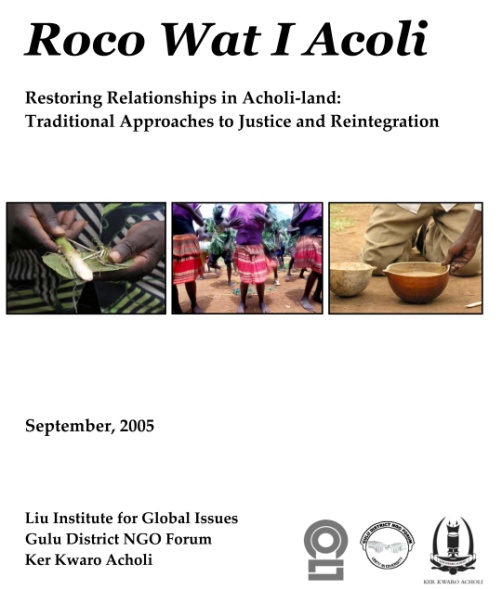
This report, Roco Wat I Acoli, provides a much needed analysis of what traditional justice in northern Uganda is, how it is currently practiced and what value it could add. It documents existing practices of traditional justice in 16 internally displaced persons (IDP) camps in Northern Uganda. It further examines how some of these rituals have been adapted to promote the reintegration of former rebels. It does so in order to provide an initial assessment of whether or not traditional rituals and ceremonies could be further adapted in the context of the enduring 19-year old conflict.
The findings suggest that the Acholi people continue to hold sophisticated cultural beliefs in the spirit world, which greatly shape their perceptions of truth, justice, forgiveness and reconciliation. Nevertheless, traditional cultural practices and the role of Elders, Mego and Rwodi have been severely restricted by the conflict and circumstances of displacement. In the words of one Elder, ‘these children don’t know how to be Acholi’. Since their re-institutionalization in 2000, traditional leaders, through Ker Kwaro Acholi, have attempted to revitalize cultural rituals and practices, and to reach out to the population to encourage the safe reintegration of formerly abducted persons. Findings suggest that this initiative has had varying degrees of success on the ground, largely dependant upon the camp setting, leadership within the camp, as well as the individual circumstances the formerly abducted person (FAP) returns to, such as family life. Likewise, the approaches are often ad-hoc and lack coordination with other existing efforts, reflecting an institutional weakness of the organization.
The initiation of an investigation by the Office of the Prosecutor at the International Criminal Court (ICC) in Northern and Eastern Uganda has sparked intense debate on its impact on the prospects for peace in the region. On one side of the debate, it is argued that the Chief Prosecutor’s timing negatively impacts the efforts of Betty Bigombe, chief mediator between the Government of Uganda and the Lord’s Resistance Army (LRA), to re-initiate talks. The fear is that the LRA will have no incentive to dialogue with the Government if they face arrest and detention. Second, the investigation provides a disincentive for rebel commanders to come out under the provision of the Ugandan Amnesty Act (2000). Third, the investigation undermines the efforts of locally-based civil society groups to support the peaceful return and reintegration of combatants under the Amnesty. On the other side, the Chief Prosecutor, Luis Moreno Ocampo’s investigation has had a positive impact, facilitating prospects for realizing sustainable peace, primarily by drawing greater international attention to the conflict and pressuring conflicting parties to resolve it.
This Human Security Update examines the origins and evolution of the two sides of the debate on ‘peace vs. justice’ and attempts to bring them into conversation. Recent efforts to exchange information and views on this topic may provide an entry point for finding a balanced approach between international and local initiatives. Both approaches have relative merits and limitations. Neither are a stand-alone solution, but a well-planned, long-term, coordinated and transparent approach could stimulate both peace and justice in the region.