Categories
Photos

West Nile Advocacy Training, February 2011

[AFG_gallery id=’24’]

From February 1-3, JRP’s Community Mobilization and Documentation teams organized an advocacy training workshop for members of the West Nile Kony Rebel War Victims Association (WNKRWVA) in Jershem Hotel in Arua town. The training included participants from Arua, Nebbi, Zombo, Adjumani, Moyo, Yumbe, Koboko and Maracha districts.

On February 4, the Association put the skills obtained in the training to good use. In a meeting facilitated by JRP, WNKRWVA met with local leaders to create awareness about the challenges they are undergoing in pursuing compensation and reparations from the Government of Uganda for atrocities they suffered throughout the conflict.

A statement written by JRP in consultation with the Association was presented to local leaders by the victims. Local leaders present included the Deputy LCV of Arua, the Deputy LCV of Nebbi, and candidates who were standing for elective positions in Arua.

Since this meeting, the group has continued to seek avenues to advance their advocacy demands to their leaders. They are currently undergoing registration of their members in a bid to solidify their demand for reparations. They have opened official files in the office of the LCV and the DISO in Arua district to update local government about their activities and maintain a conducive working relationship.

Categories
Photos

Teso TJ Policy Consultation, February 2011

[AFG_gallery id=’23’]

From February 9-10, JRP, in collaboration with South Africa-based Institute for Justice and Reconciliation (IJR), carried out the third in a series of consultations with victims to gain their perceptions on different transitional justice mechanisms.  The consultations were part of a series titled, “Enhancing Grassroots Participation in Transitional Justice Debates,” aimed at intensifying local advocacy in northern Uganda around issues of truth-seeking, reparations, traditional justice, and gender justice ahead of the 2011 presidential and parliamentary elections. Earlier consultations were held late last year in West Nile and Acholi/Lango.  Like in the first two consultations, participants were eager to share their views on the relevance of different mechanisms and to state the importance of processes to foster healing and reconciliation. As it is across the greater North, victims in Teso prioritized compensation from the Government of Uganda for crimes committed by state and non-state actors.

To read the event’s press release, click here.

Categories
Photos

Norwegian State Secretary Visit, February 2011

[AFG_gallery id=’22’]

On February 6, the Ambassador of Norway visited our office with the State Secretary in the Ministry for Foreign Affairs, Ingrid Fiskaa. The State Secretary was interested in learning about gender and equality, so we incited the collaboration of Ododo Wa:Our Stories and a women’s group they work closely with. In addition to team leaders providing short presentations on their work, the women performed an original drama on the subject, what they viewed as ‘gender inequality.’

This visit was an important opportunity to showcase our work and to share experiences. JRP is funded with generous support from the Norwegian Embassy in Kampala.

Categories
Press Releases

“Teso—Enhancing grassroots involvement in transitional justice debates,” JRP, 8 February 2011

FOR IMMEDIATE RELEASE

February 8, 2011


MEDIA ADVISORY

Enhancing grassroots involvement in transitional justice debates

SOROTI— From February 9-10,2011, the Justice and Reconciliation Project (JRP), in partnership with the South Africa-based Institute for Justice and Reconciliation (IJR), will hold a two-day grassroots consultation in Soroti to explore local perspectives on transitional justice.

As the third in a series of three consultations, the Teso consultation will be held at the Landmark Hotel in Soroti Town, and will engage local-level, grassroots persons directly affected by conflict to ensure that their opinions are not left out of the wider discussions. Thirty participants, comprising primarily of victims and victims’ groups and religious and cultural leaders from across the sub-region, will convene to share views on truth-seeking, traditional justice, community reparations and gender justice.

Previous consultations were held in West Nile from November 24-25, 2010, and Acholi/Lango from December 1-2, 2010. The findings from the three consultations will be presented at a regional meeting later this year and will work to influence policy recommendations for the implementation of key transitional justice mechanisms in the region.

These consultations are part of a larger JRP/IJR joint project, titled “Enhancing Grassroots Participation in Transitional Justice Debates,” which aims to intensify local advocacy and consultation of victims in northern Uganda around issues of transitional justice in light of the 2011 presidential and parliamentary elections. Since last year, JRP/IJR has held extensive consultations with a broad range of stakeholders, including grassroots communities, JLOS (Justice, Law and Order Sector), CSOs and local government leaders to gain a clearer sense of how justice needs can be met.

Media are invited to attend the opening and closing sessions of each of the regional consultations. For more information, email info@justiceandreconciliation.com or call Lindsay McClain, JRP Communications Officer, at +256 (0)471433008 or +256 (0)783300103. Or, visit us on the web at www.justiceandreconciliation.com or www.ijr.org.za.


About JRP

The Justice and Reconciliation Project (JRP) promotes locally sensitive and sustainable peace in Africa’s Great Lakes region by focusing on the active involvement of grassroots communities in local-level transitional justice. They are based in Gulu, northern Uganda.

About IJR

The Institute for Justice and Reconciliation (IJR) promotes for reconciliation and socio-economic justice in Africa through strategic partnerships and carefully constructed interventions. They are based in Cape Town, South Africa.

To download this press release, click here.
Categories
In the News

“Victims of LRA demand compensation,” Daily Monitor, 7 February 2011

“Victims of LRA demand compensation,” Daily Monitor, 7 February 2011

http://www.monitor.co.ug/News/National/-/688334/1102898/-/c58m75z/-/index.html

By Warom Felix Okello


West Nile

Hundreds of people living near Murchison Falls National Park who survived attacks by the Lords’ Resistance Army rebels are demanding compensation from government.

Some of the residents suffered bullet wounds, lost their property while others had their relatives killed during numerous ambushes in the park- the epicentre of the attacks in West Nile.

Under the West Nile Kony Rebel War Victims Association, they are demanding that financial compensation and support be given to them. The association chairman, Mr Sam Buti, said: “Even though we suffered tremendously, we have not received any substantial support from the government which should have ensured our protection,” he said.

Records by the association indicate that Nebbi has 500 victims, Arua 400, Zombo 300, Yumbe 200, Koboko 250 and Adjumani 600. Mr Buti said the over 2,750 war victims are mainly from the urban areas.

“We lack finances to enable us trace those in rural areas. If bomb victims can be compensated within days, why not us?” he asked.

Awaiting return
Ms Norah Fuathuma, whose child was abducted, said she is still waiting for the return of his son whether dead or alive. “I think the ICC should come to our rescue because I think our leaders are not mindful of compensating us. The LRA leaders should in fact be taken to ICC because the use of force is not yielding any fruit,” she said.

Joseph Kony has led the LRA in its guerrilla-style war against the government forces, leaving civilians in northern Uganda caught up in the war. Thousands of people were killed, houses burnt, children and women abducted, as the government sent hundreds of residents into internally displaced camps.

A peace effort between the two groups, mediated by South Sudan’s Riek Machar yielded no fruit in 2006. As the sound of guns fell silent, residents are returning to their villages and rebuilding their lives.

Categories
Photos

Norwegian Ambassador Visit, January 2011

[AFG_gallery id=’21’]

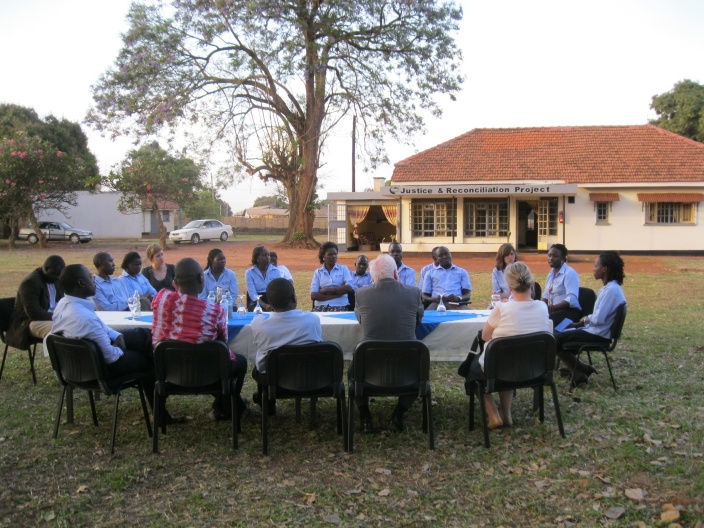
On January 24 JRP welcomed Norwegian Ambassador H.E. Thorbjørn Gaustadsæther to our offices. His visit provided an opportunity for our team to share more about our work and experiences with him. For one hour, we sat under the shade of a compound tree, discussing our work-streams and answering questions about our activities asked by the Ambassador.

This interaction was an important opportunity to showcase our work and to share experiences. JRP is funded with generous support from the Norwegian Embassy in Kampala.

Categories
Reports

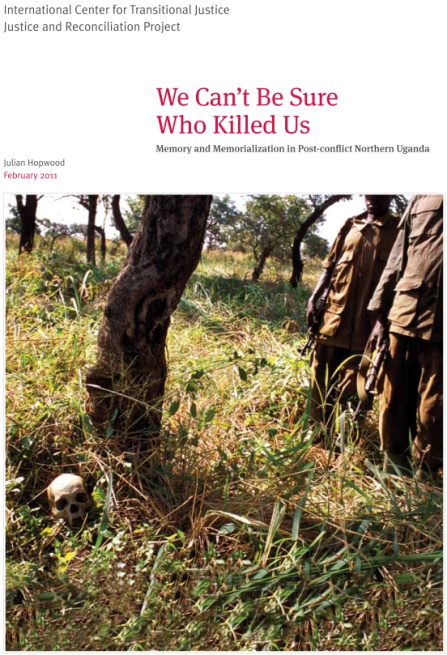
We Can’t Be Sure Who Killed Us: Memory and Memorialization in Post-Conflict Northern Uganda

The skull of a victim rests at the Barlonyo massacre site, 2006

A Joint Report by JRP and the International Center for Transitional Justice (ICTJ)

With funding from the Austrian Development Cooperation

Written by: Julian Hopwood

 This report examines the role memorials have played in Uganda’s transitional justice process. Addressed to community members, conflict survivors, policymakers, and donors, it reviews existing memorials and offers recommendations to those seeking to initiate new memorial activities. It is based on research conducted in the Acholi and Lango sub-regions of northern Uganda, involving the eponymous ethnic groups.

 To access the report, click here

Categories
Press Releases

“Victims of war in West Nile receive advocacy skills training,” JRP, 1 February 2011

FOR IMMEDIATE RELEASE

February 1, 2011


Victims of war in West Nile receive advocacy skills training

ARUA— From February 1-3, 2011, the Justice and Reconciliation Project (JRP) will hold a three-day workshop in Arua to train victims of war in West Nile on how to use advocacy strategies to seek redress for the transitional justice issues that affect them most. On Friday, February 4, 2011, the participants will implement their training in a meeting with local leaders to seek justice solutions for war victims in the region.

This training and meeting will be held at the Jershem Hotel in Arua town with members of the West Nile Kony Rebel War Victims Association, and will engage local-level, grassroots persons directly affected by conflict to apply advocacy and lobbying strategies to their demand for justice for past abuses.

Participants will explore a variety of advocacy and lobbying strategies including: problem identification and analysis, proposal and objective formulation, and strategy implementation. These tools will help victims identify “what needs to be done?” and “how?” During the course of the training, victims will formulate a statement to be presented to local leaders at Friday’s meeting.

This training is part of a larger initiative by JRP to ensure that the opinions of victims are not left out of the wider discussions on transitional justice issues such as community reparations, truth-seeking, reconciliation, traditional justice, and gender justice.

Media are invited to observe portions of the training sessions and to cover the meeting with local leaders. For more information, email info@justiceandreconciliation.com or call Sylvia Opinia, JRP Community Mobilisation Team Leader, at +256 (0)471433008 or +256 (0)772332353. Or, visit us on the web at www.justiceandreconciliation.com.


About JRP

The Justice and Reconciliation Project (JRP) promotes locally sensitive and sustainable peace in Africa’s Great Lakes region by focusing on the active involvement of grassroots communities in local-level transitional justice. They are based in Gulu, northern Uganda.

To download this press release, click here.
Categories
Reports

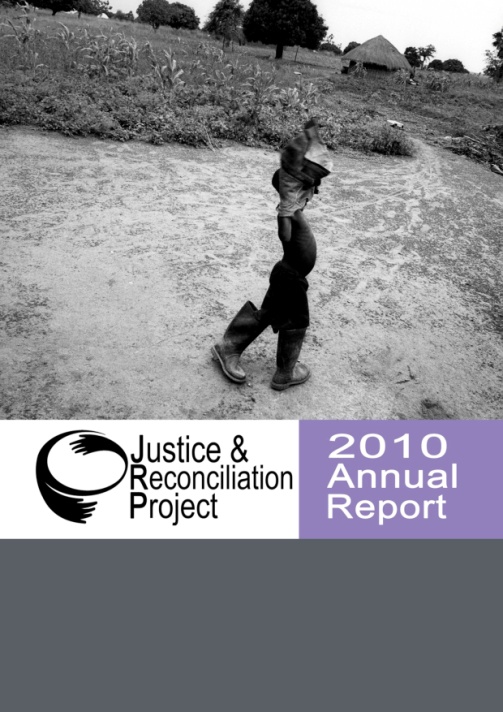
2010 Annual Report

A boy stands playfully in a returned homestead in northern Uganda

The year 2010 presented a significant step in the future of JRP following the transition from a project created in 2004 to an independent NGO with headquarters in Gulu. JRP has a national mandate to carry out transitional justice activities in Uganda. During the past year, the staff at JRP — together with our student interns, community volunteers, local victim groups and partners — made significant contributions towards the success of planned programs for the year. In particular, working in over twenty local communities in north, northeastern and West Nile regions presented us with unique insights into war-affected communities’ quests for justice, reconciliation and sustainable peace in Uganda.

 Our engagements in mobilizing civil society across Acholi, Lango, Teso and West Nile sub-regions for meaningful participation in discourses on justice and reconciliation provided an opportunity for us to re-echo our commitment of ensuring that victims should be at the centre of every stage of developing any transitional justice process in Uganda.

 Some key areas of our engagements in the past year include empowering victims to articulate their own positions on transitional justice, for instance the ‘Women’s Gender Justice Statement,’ which was circulated to policy-makers and to a wider audience nationally and internationally. We also mainstreamed gender-related concerns affecting young, formerly abducted mothers in most of our work with civil society, whilst ensuring that our documentation programme amplifies the voices of the young and vulnerable women in northern Uganda. In doing this, we integrated within JRP a unique documentation project, Ododo Wa: Our Stories, where several women were engaged in participatory research and training in leadership and advocacy skills. A testimony by one young woman we worked with sums it all up. She remarked, “…for long we victims of torture, rape and forced marriage have remained silent. Today we have the chance to speak on our own behalf marking an end to a long period of silence. My story has got a healing power and a testimony that many other girls went through the same suffering.”

 In addition, our unique action-oriented research interventions led us into publishing important local-level based research reports such as As Long as You Live, You Will Survive on the Omot massacre providing additional insights into ‘what needs to be done’ to ensure that the justice needs of the voiceless are brought to the attention of civil society and policy-makers.

To access the report, click here.

Categories
Blog

Norwegian Ambassador Visits JRP in Gulu

 JRP with the Ambassador of Norway and staff

On January, 24th, the Norwegian Ambassador, H.E. Thorbjørn Gaustadsæther, visited JRP in a visit to northern Uganda. There he interacted with staff and learned more about transitional justice issues facing communities in the region.

This visit provided an opportunity for our team to share more about our work and experiences with him. For one hour, we sat under the shade of a compound tree, discussing our work-streams and answering questions about our activities asked by the Ambassador.

JRP is funded by the Norwegian Embassy in Kampala and wishes to thank the Ambassador for Norway’s generous support to our activities.