Categories
Blog

Workshop on Transitional Justice

The indictment of the top five rebel leaders has raised both fears and expectations, for how it might impact the Amnesty process, any future peace talks and possibly led to the capture and arrest of those deemed most responsible. In this context, questions and debate about the best way to pursue justice are extremely pressing in Uganda.

In order to begin to explore these questions in the context of northern Uganda, the Gulu District NGO Forum, International Center for Transitional Justice and Liu Institute for Global Issues convened a workshop among main stakeholders on March 17-18 at the GUSCO Peace Centre, Gulu. Participants included the Amnesty Commission (including its head, Justice Onega), the Ugandan Human Rights Commission (Commissioner Alero Omara), traditional leaders (including an opening by Rwot David Onen Acana II, Paramount Chief of the Acholi), religious leaders, NGO and civil society activists from across the country, women’s groups and youth leaders, academics from Gulu and Makarere, UN representatives (OHCHR and UNICEF), MPs, and others, including representatives from IDP camps in Kitgum, Pader and Gulu Districts.  Between 60 and 70 participants in total attended and momentum throughout the discussions was very high, with most sessions going over time.
Categories
Field Notes

Abomination: Local belief systems and international justice, FN V

Local contexts must begin to better inform Western-based approaches to transitional justice; without them, external interventions often fail to resonate with the values, norms and beliefs of victims. To illustrate this point, this edition of Field Notes focuses on the Acholi concept of kiir, or abomination. Kiir is a transgression of the moral order which is believed to cause serious misfortune, including disease, spiritual haunting and death. Not only has the conflict in northern Uganda created the conditions that have allowed these transgressions to occur; the conflict has also been called an abomination in and of itself. A curse on the people of Acholi and consequent mass displacement are thought to have multiplied acts of abomination as well as reduced the capacity to deal with them: a cleansing ceremony must be performed in order to rectify the impact of kiir.

This Field Note attempts to bring the reader closer to an understanding of local belief systems. Gaining insight into these beliefs can aid international justice systems to better reflect the lived realities of the victim population.

To access the report, click here.

Categories
Statements & Briefs

Declaration by Northern Uganda Civil Society Organizations on Agenda Item 3 of the Juba Peace Talks (Accountability and Reconciliation): Acholi, Lango, Teso and West Nile Regions

Between the 20-30 August 2007 CSOs working on peace, justice and reconciliation activities in Northern Uganda held four consultative meetings in the regions of Acholi, Lango, Teso, and West Nile to reach a common position on the ongoing consultations on accountability and reconciliation.

A draft committee consisting of three representatives from each sub-region met in Gulu from the 6-7 September 2007 to come up with a common position for CSOs in Northern Uganda.

It is from the proceedings of this meeting and based on regional consultations that we derive the contents of this memorandum, which we hereby declare as a common position for CSOs in Northern Uganda.

To access the declaration, click here.

Categories
Statements & Briefs

Lira Declaration on Agenda Item 3 of the Juba Peace Talks (Accountability and Reconciliation) by Cultural and Religious Leaders, Women and Youth from Madi, Teso, Lango and Acholi Sub-Regions

This declaration was signed by cultural and religious leaders in the sub-regions of West Nile (Madi), Teso, Lango and Acholi after the first anniversary of the Juba Peace Talks.

The declaration made several recommendations in the areas of truth, reparations, reconciliation and complementarity. Noteworthy is the call for traditional justice mechanisms to be used for justice and reconciliation.

To access the declaration, click here.

Categories
Reports

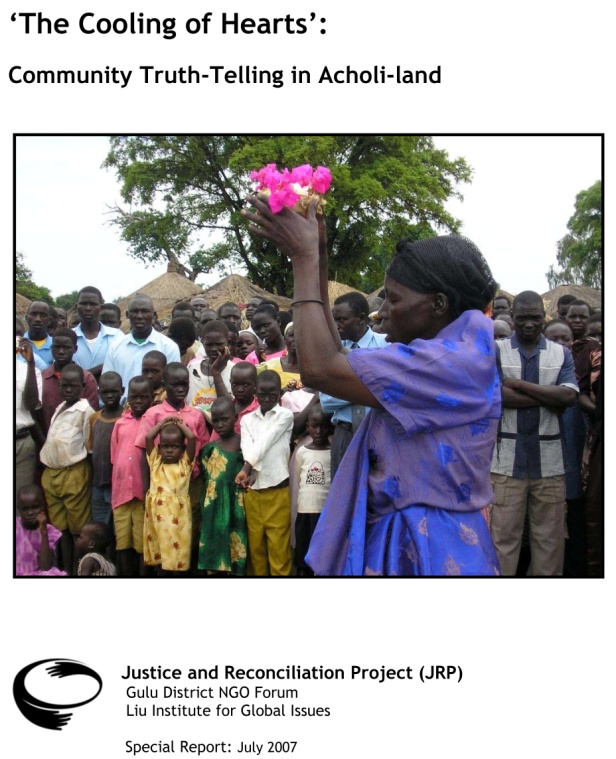
The Cooling of Hearts: Community truth-telling in Acholi-land

A woman lays a wreath at the Attiak memorial service, 2007

Recent national and international debates on truth and reconciliation in Uganda have emphasized the importance of incorporating local level mechanisms into a transitional justice strategy. This report seeks to contribute to this discussion by focusing on local level mechanisms in Acholi-land and determining how these might promote truth-telling and reconciliation at the community level.

 Underlying the research are three main objectives: to assess whether or not grassroots, war-affected persons in the region want a truth-telling process; to assess the possibilities of adapting local mechanisms to promote truth and reconciliation at the community level; and lastly, to present the results, observations and recommendations found in this report to relevant policy-makers (the Government of Uganda, local-level leadership in Uganda, and the international community). The research reveals that there is indeed a need for a truth-telling process in northern

Uganda. Few atrocities have been documented or acknowledged publicly – most are contested and highly controversial. As a consequence, victims struggle to survive emotionally, socially and economically with tragic memories of loss, and with little to no high-level acknowledgement by the

Government of Uganda or by most of the LRA high command.

 To access the report, click here.

Categories
Field Notes

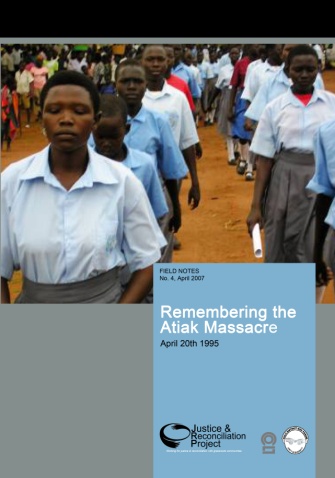
Remembering the Atiak Massacre: April 20th 1995, FN IV

Students in Atiak
Students in Atiak

On April 20th 1995, the Lord’s Resistance Army (LRA) entered the trading centre of Atiak and after an intense offensive, defeated the Ugandan army stationed there. Hundreds of men, women, students and young children were then rounded up by the LRA and marched a short distance into the bush until they reached a river. There, they were separated into two groups according to their sex and age. After being lectured for their alleged collaboration with the Government, the LRA commander in charge ordered his soldiers to open fire three times on a group of about 300 civilian men and boys as women and young children witnessed the horror. The LRA commander reportedly in charge – the now indicted second in command Vincent Otti – then turned to the women and children and told them to applaud the LRA’s work. Before leaving, youth were selectively rounded up and forced to join the LRA to serve as the next generation of combatants and sexual slaves.

Twelve years later, the wounds of the massacre have far from healed. As the survivor’s testimony at the beginning of this report puts it, “all of us live as if our bodies do not have souls.” Despite the massacre being one of the largest and by reputation most notorious in the twenty-one year history of the conflict, no official record, investigation or acknowledgement of events exists. No excavation of the mass grave has been conducted and therefore the exact number of persons killed is not known. Survivors literally live with the remains of bullet fragments inside them. Although the massacre site is only a few kilometres from the trading centre, a proper burial of those slaughtered 12 years ago is not complete: as one survivor reminds us, “the bodies of some people were never brought back home, because there were no relatives to carry them home.”

This report seeks to provide the first known written record of events leading to the massacre based on the testimony of 41 survivors and witnesses, as well as prominent community members. It does not claim to be complete, but rather provides a partial record in hopes of prompting the Government to begin an investigation into the multiple massacres that have taken place in Uganda. Ideally, this will lead the Government to advance a transitional justice strategy, together with civil society, that will begin to heal the open wounds of Atiak. To this end, recommendations are advanced in the final sections of this report.

To access the report, click here

Categories
Statements & Briefs

Challenges in the Pursuit of Transitional Justice: A Case of Northern Uganda (by Michael Otim)

From April 16-18, Michael Otim attended a meeting in Oslo, Norway, titled, “Transitional Justice and Peace Negotiations.” The meeting was hosted by the Norwegian Minister of Foreign Affairs and the International Center for Transitional Justice.

Michael presented this paper during the meeting to update participants on the current transitional justice debates taking place in northern Uganda.

 To access the paper, click here.

Categories
Statements & Briefs

Traditional Justice and Reintegration of Reporters in Northern Uganda

By Kica Richard Ocaya and Ketty Anyeko

This concept note was prepared for presentation in a training workshop on information, counseling and referral services for reporters (formerly abducted persons) organized by the Amnesty Commission for its technical staff.

To access the briefing, click here.

Categories
Reports

Grassroots Perspectives of Forgiveness and Reconciliation: Report of the Dialogue in Kitgum Matidi [1]

With the peace versus justice debate in Northern Uganda reaching a crescendo, different views have been expressed, with the majority focusing on peace through amnesty and a process of reconciliation. Local politicians, civil society organizations (CSOs), cultural and religious leaders have spoken strongly on behalf of the Northern population in support of forgiveness and reconciliation of the LRA, without necessarily consulting with grass-roots people they represent.

The dialogue below was conducted by the JRP in the internally displaced camp of Kitgum Matidi on the 9th of November 2006. It explores a variety of views of grass-roots actors on the theme of forgiveness and reconciliation. It finds that no general consensus exists on the desire or will to extend forgiveness to the LRA at this time. For some, forgiveness is not a choice but is derived out of the reality in which they live. “As for forgiveness, it appears like we have no option but to accept it. This is because we do not have weapons like our brothers in the bush. Since we do not have the weapons, we have no option but to accept.”

 Grass-roots participants in the dialogue did not agree that mato oput, a process of restorative justice leading to a ceremony designed to promote reconciliation of two conflicting parities, could or should be performed in the context of on-going war.

 The sequencing of peace and justice is viewed as extremely important by some grassroots actors: peace is a pre-requisite of reconciliation, and peace entails the ability to return and reconstruct homesteads, livelihoods, and fulfillment of basic human rights and freedoms. As one woman stated, “take a look at the camps….am I supposed to forgive from this mass homestead? For me to forgive I feel we should first go back home, so that I can forgive the person who hurt me from my own homestead.”

To access the report, click here.

Categories
Field Notes

Accountability and Reconciliation at the Juba Peace Talks: Beyond the Impasse, FN III

As peace talks between the Lord’s Resistance Army (LRA) and the Government of Uganda proceed in Juba, many anticipate the forthcoming discussion of the third agenda item on Reconciliation and Accountability. The LRA leadership has repeatedly stated that no fighter will return home unless the Prosecutor of the International Criminal Court withdraws indictments against four of the remaining five commanders still alive.

This paper suggests ways to move beyond the current impasse. It identifies a series of current justice and reconciliation alternatives available. By placing an emphasis on what can be discussed in the peace talks, it hopes to illustrate means of realizing both peace and justice.

To access the report, click here.